He who hears the shema drinks the shekar!

Showing posts with label Theology. Show all posts

Friday, April 10, 2009

Herman Bavinck on Confession and False Shame


But I certify you, brethren,
that the gospel which was preached of
me is not after man.
Gal. 1: 11.

Confessing is against flesh and blood, against the world and Satan. By nature, each man is an enemy of the preaching of the cross of Jesus Christ. It may seem strange to the shallow minded person, that there has always been so much resistance against the gospel. For it is a joyful message for all creatures; it speaks of nothing but grace, peace and salvation; it demands nothing, but gives everything. Yet, it finds enmity and resistance all over; it is an offense to the Jew and foolishness to the Greek. It may be for man, it is not after man. It is of Divine origin and therefore not in accordance with the thoughts and desires of men. Mind and heart, desire and will, soul and body are against the gospel of Christ. In their resistance men are supported by the world and the whole kingdom of darkness.

There certainly is a difference in circumstances. In days of peace and quiet, it is less serious, then when the congregation is oppressed and persecuted by the world. We need more courage to confess Christ, in an ungodly environment of sinners and mockers, than in the circle of relatives and friends, who together confess the truth. It needs a more courageous faith, not to be ashamed of the cross of Christ, when surrounded by the great and learned, than in the midst of common people in a distant village.

But in principle the resistance is the same all over. For flesh, the world and Satan are always the same, and the greatest and strongest enemy that resists the confession of Christ, lives in our own heart. The forms in which the enemy operates may be different, but confessing the name of Christ always demands that we deny self and bear His cross. Whoever, from which circle he may come, when he will follow Jesus, must submit to insult an contempt.

Even when faith is worked in the heart, and urges to confessing, there still can be so much that keeps the lips closed, and keeps us from boldly confessing the name of Jesus!

Look at Peter, who in a hour of danger denies his Master, and later in Antioch from fear for the brethren of the circumcision turns into a hypocrite. Yet, Peter was first among the apostles, who for his glorious and courageous confession that Jesus was Messiah, received the name of Rock. He felt so close to Jesus, had such fervent love for the Master, that he would die for the Lord, and did not think it possible he would ever deny his Lord. When Peter could fall and did fall, who shall remain standing? And who does not need the warning: let him that thinketh he standeth, take heed lest he fall.

There are many examples in the history of the Christian Church, where we read of steadfast martyrs, but we also read of the thousands, who denied the faith in the hour of temptation. When oppression and persecution come for the sake of the Word, those, who at first heard the Word with joy, but had no root in themselves, are instantly offended, and are but for a time.

There are so many dangers to which the believer is exposed, so many rocks at which he can suffer shipwreck. The desire of the eyes, the lust of the flesh, the pride of life, fear to lose name and honor, good and blood, work together to draw Christ's disciple away from the certainty of faith. Among all these temptations, a so-called sense of false shame could be the most severe of all. For even when oppressions and persecutions are past, it continues to slay its thousands and ten thousands. Among the low and mighty, this sense of false shame kept many from confessing the name of the Lord.

There is something very humiliating in the thought, that basically, in our hearts, we are ashamed to confess Jesus. For He was a man going through the country, doing good and blessing men; Who was meek and lowly of heart; Who being innocent, died on the cross, being condemned by those who were His enemies. There must be something out of order with us, we must be spiritually sick, when we are ashamed for such a Man, and are afraid to take His name on our lips.

Shame in general is an unpleasant feeling, which connects itself with some act in us, as if the esteem from others for us becomes less. It can be something positive. When Adam after he sinned is ashamed because he trespassed the commandment, he gives evidence that he sees his act as evil and is aware that he fell. To be ashamed is not always a fruit of faith, it is also known by the natural man, and is evidence that men did not become animal or devil when he fell. He is still man, and a feeling of dignity and honour remains with him.

But beside much that is true and good, there is also a false sense of shame. It occurs when we feel embarrassed about something, which is good in itself, but can lower us in the esteem of others. We are often ashamed for the good impressions that are left from the preaching of the gospel; about the accusations of our conscience; about the sorrow that we feel after a sin committed; about emotions to which we are subject at certain times. We are afraid that others knowing about this, will despise us, and make fun of us; that we will lose the name of being courageous and strong people.

It is this sense of false shame, which often surprises us with respect to the gospel of the cross. We are ashamed of the congregation, which consists not of many nobles, not many wise. We are ashamed of the Bible, which is so different and is contested by men of science and culture. We are ashamed of Christ, Who claimed to be God's only Son, the anointed of the Father. We are ashamed of His cross, which was an offense to the Jew, and foolishness to the Greek. We are ashamed of God's special revelation, which discovers us to ourselves, and shows us in our spiritual poverty.

We are also afraid when taking the side of Christ, we will lose our name and honour as men and become subject to insult and mockery, libel and oppression. We fear, that by confessing Christ, our dignity, our personality, our being human will suffer harm.

Even a sense of false shame has the dark underground, that at one time we were created in God's image and must uphold a certain honour and status. No one is indifferent to the esteem of self and of others, because in his deepest fall, man remains man, that is, he still retains the image and likeness of God.

But under the influence of sin this sense works the wrong way. For it is true indeed when we give ourselves to Christ for our salvation, the esteem of ourselves and that of others will lessen and we will lose our name and honour by men. But such esteem is nothing but delusion, and such honour and delusion are but imagined. For by nature we see ourselves as rich and enriched, having need of nothing. But when we embrace the gospel, we see that we are poor and blind and naked.

That is how the honour of men is for the greatest part nothing but ignorance and show. The art of associating with man consists in hiding our real being, so they form a judgment about our person, according to our outward, acquired behaviour. God is true, but all men are liars. Man just does not happen to speak lies, but he lives a lie; he is untrue in his very existence. Appearance and substance, being and revelation, inward and outward do contrast each other. While at times the mouth flows over with love and the countenance shows nothing but friendship, from the heart of men proceed evil surmisings, murders, fornication, adultery, theft, false witness, slanders. A saint, who knew the inner man and could see the bottom of the heart, would flee from him, horror stricken. And unforgettable is the love of Christ, Who knew man, but in spite of this looked for him and gave Himself over into death for him.

That is how we live for ourselves and others in a delusion and imagination. Well considered, we abandon nothing, when we believe in Christ, for we have nothing. We only abandon the delusion that we are rich and enriched, that we have need of nothing. The greatest misery of sin is not that we are blind, but being blind we think that we see. Sin is guilt and shame and stain, but it also is foolishness and lack of wisdom.

That delusion is disturbed in us by the Word of the Lord. If we would be saved by Christ we must do away with that delusion. For to become a Christian is to esteem the judgment of others for nothing, accepting the judgment of God upon ourselves and hope in His grace. To confess Christ includes, that we lose ourselves and all that is ours, our name and our honour, our good and blood, our soul and our life. It is exactly this that is resisted by a sense of false shame. The desire to apparent self preservation, urges and drives men to resist the gospel with all his strength.

"Because the carnal mind is enmity against God: for it is not subject to the law of God, neither indeed can be." (Rom. 8: 7). The natural man does not understand the things of God's Spirit, and he does not understand, that denial of self is the only way to true self-preservation.


from The Sacrifice of Praise, Chapter 7

Friday, December 14, 2007

The Wright View of Penal Substitution?

Many people know by now the name, Steve Chalke, in connection with the doctrine of Christ's penal substitutionary atonement. In his 2004 The Lost Message of Jesus, Chalke in a not-so-subtle way argued that the whole classic notion of 'penal substitution' amounts to a form of "cosmic child abuse." While I was busy figuring out 'the Canadian life' and immersing myself in OT historical narratives, Chalke's book stirred up quite the hornet's nest across the pond. Books have been written in response and all sorts of responses have come and gone.

Lee Irons pointed out to me a couple months ago about the frequency you see the word 'violence' in books and articles these days in broad evangelical circles; it's all part of a recent trend seeking to recast (if not openly deny!) 'penal substition' because it seems to advocate a message that 'postmoderns' don't wont to hear or can't understand.

Like many of these modern theological issues, N.T. Wright injected himself into the discussion earlier this year via a 'quasi-defense' of Chalke's book. While not endorsing the book per se, he certainly wasted no time blasting those critical of Chalke. As with many of these issues, the questions always seems to come down to: What does Wright
really believe about ________?

In November 2007, Wright was interviewed while visiting Asbury Seminary, and the full transcript of that interview can be found here. There's plenty here to comment on, but I'll limit it to his brief discussion about penal substition. Two quotes worth noting:

And the one-liner which he [Chalke] drops in was not, in its origin, a way of saying, “I don’t believe in penal substitution.” It was a way of ruling out of court to one side a distortion of penal substitution which he has heard, which I have heard – the idea of God simply wanting to punish somebody and not caring too much who it was. Oh, well, here’s an innocent man. Let’s punish him and that will be alright, won’t it? Sadly, there are many Christians who preach the doctrine like that.

and then a little bit farther down:

So we have to understand the doctrine of penal substitution within the Scriptural framework, within which it makes sense, rather than within this very low grade thing that I’ve been a naughty boy, God wants to punish me, and for some reason, he punishes someone else, so phew! I’m alright. OK. For a five-year-old, that’s fine. That’ll maybe do it. But, actually let’s grow up! We’re not talking about five-year-olds here; we’re talking about grown men and women who ought to know better, to be honest.

I'll grant for sake of argument that there are probably some Christian ministers that preach the doctrine of 'penal substitution' in an unbiblical way. But when Wright speaks of this "...idea of God simply wanting to punish somebody and not caring too much who it was," I honestly have to wonder just
who he's speaking of. If this version of 'penal substitution' is out there, I certainly don't know where it exists, let alone who is teaching it. Even the most committed 'hell, fire, and brimstone' preacher that beats people up with the Law -- a significant error in its own right -- would not recognize this sort of caricature that Wright imagines. The fact that Wright would seek to defend Chalke on the premise of a non-existent view of penal substitution is quite troubling, even taking into account the quotations Jim Hamilton and Trevin Wax have gathered to demonstrate that Wright personally holds to a doctrine of penal substitution.

When you put it all together, I don't have a whole lot of confidence that N.T. Wright understands
penal substitution correctly, for the simple reason that all these loose ends in Wright-speak simply do not cohere. I'm inclined to think the Oakhill men (Steve Jeffery, Mike Ovey and Andrew Sach) are surely right to identify their disagreement with Wright as a "methodological one" at its core. In other words, this cannot be written off simply as a matter of emphasizing one thing more than the other; Wright seems to be tolerating a fundamentally different way we should think about the atonement.

For a nice survey of the classic doctrine of penal substitution, check out J.I. Packer's recent article here. One can't help but notice a substantial difference between these two Anglicans! Packer is certainly aware of these theological developments in his native homeland, and holds nothing back in exposing precisely why this notion of 'cosmic child abuse' is wrong on just about every level.

UPDATE (Dec. 20): You can read Lee Irons' further elaboration on this post at the Upper Register blog.

Friday, March 30, 2007

More Covenantal confusion....

You have to appreciate the courage of C. FitzSimons Allison (ret.) in standing up to the utter nonsense that the Anglican powers-that-be are producing these days.

Surely what is becoming increasingly obvious is that we have two different religions in one church...

His response to Katherine Grieb's earlier proposal is a great example of seeing through her erroneous invoking of 'covenant' in defense of her sub-Biblical agenda.

Just because it looks like 'covenant' and quacks like 'covenant'....doesn't mean it's a biblical covenant! Bravo Allison.

[HT: Jeff Hutchinson]

Wednesday, March 28, 2007

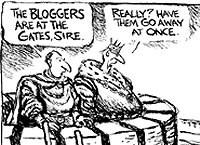
Bloggers beware....

I understand the antipathy many of my friends have towards the blogosphere.

Kim Riddlebarger recently made this point well, showing how the web instantly makes 'everybody a theologian'! I wonder if it's yet another variation of the 'every member is a minister' confusion that is well-intended but not always well-founded. There are a lot of people 'blogging' that simply don't know what they are talking about.

An even greater concern to me is the level of vitriol that often ensues when discussion/debate demonstrates two (or more) groups on the opposite side of the fence. And this is where the blogosphere (just as e-mail has been for the past decade) is a two-edged sword. It has a great potential of disseminating helpful information...but it disseminates a lot of vitriol of people that would be better off guarding their tongue. Indeed it can be a fire, a world of unrighteousness (James 3:6). Blogging is yet another extension of the tongue.

But I wonder sometimes if people would say in person the same things they write on their (and other) blogs. It's a worthy question to ask before you post anything to the public or respond on someone else's blog.

This is one reason why I rely so heavily on journals and books from established schools and publishers. I just don't have time for empty rhetoric with no substance. Just give me your Biblical, exegetical, theological or historical argument.....back it up with documentation....and leave all of the personal antidotes out!! That doesn't mean everything in journals is worth reading. But on the whole, it's a more productive use of my time.

Life is just too short to be wasted reading armchair theology.

Tuesday, March 13, 2007

Ridderbos passes away at 98


Here's my Google chat quote of the day....courtesy of Adam York:

did you know that ridderbos passed away last thursday?
i didn't know he was still alive.


You have to realize that Herman Ridderbos was first published (correct me if I'm wrong!) in the early 1940's. So this guy has been around for a long, long time. Most of his significant and ground-breaking work took place decades ago, and he's kind of dropped off the map in recent years. I think most of us presumed he must have already passed on to glory.

His work is first-rate. His Paul: An Outline of His Theology remains the best and most-influential (yea, monumental and comprehensive!) work I've ever read on Paul's theology. It'll do more for your reading of Paul's letters than any commentary on a Pauline letter that I've seen. It's still ranks in my 'Top 5' favorites books.

His Coming of the Kingdom is one of the best (if not THE best) theological introductions for reading the Gospels. His Redemptive History and the New Testament Scriptures is a very helpful look at the topic of the canon from the vantage point of salvation-history.

And his When the Time Had Fully Come is a little gem of a book. I still remember buying up about 20 copies of that book for $5 a pop from some New York bookstore that obviously had no idea what they had on their hands! In many respects, it summarizes the thrust of the three previously mentioned books.

All excellent stuff. He will certainly be missed.

[HT: Matthijs den Dulk]

Saturday, February 10, 2007

Resolved - I will never let the blog become....


Blogging can be a good thing -- sharing pictures, exploring rhetoric, posting links to interesting reading, an occasional joke or story, etc.

The latest 'dia-blog' between Clark and Wilson is not such a good thing. It proves my point that 'genuine debate' can't take place in a medium given over to what I call, 'sound bite theology.' [How many people have chimed in on this debate? Far too many...and I don't much advise you trying to follow it all!]

Some of the rhetoric went from polemically interesting to unabashedly vitriolic.....and how are all those (300+?) 'comments' suppose to help?

Sound bites may work when commenting about a photo....but blogging is no way to do theology! [The sarcasm doesn't help either!]

Can you imagine the Westminster Divines trying to argue out the implications of the 'obedience of Christ' on.....Myspace? Maybe it's just me...but I don't find it terribly inviting to discuss Robert Baille and Richard Vines with someone named....'HypezAznTmboySrfGrl'! I rest my case....

This is not to say the issues are moot. Mai Genoita! Take up
Turretin's Institutio Theologiae Elencticae (by way of example), and note the precise nuances when discussing faith (fide). You just can't get that kind of precision on a blog. And at the end of the day, I think Wilson is off the mark here...but that's a matter left for another day.

As my buddy Dave (aka the 'Hebrew Hammer') has quipped numerous times (in various versions): "All the good stuff worth reading is published in journals and books, not someone's blog!"

There is much wisdom here from 'the Hammer' worth pondering. And one of the things that concerns me about 'Theoblogging.' To publish in a journal and/or book is no small thing. It requires careful writing, editing, re-editing, peer reviews, final drafts, etc....sometimes taking months, even years! Often times with people that strongly disagree with you! But the process is there for a reason -- (a) it cleans up rhetoric; (b) it helps weed out bad argumentation; and (c) it encourages sober reflection and self-criticism.

Of course, journals and books don't perfectly suceed in doing these things, especially now that you can self-publish just about anything you want for relatively little cost. But when an article/book comes out in a significant quarterly/publishing house, there's a much better chance you are reading something that is actually worth reading.

So I hearby resolve.....to never let this blog become some massive theological outpost, attempting to solve all of the rumblings going on in the Reformed world! This is blog, not a theological journal. And if it ever becomes a Clark-Wilson burned-over district, I give Lu-O permission to take her Liddel-Scott dictionary and beat me over the head with it!