He who hears the shema drinks the shekar!

Showing posts with label Kline. Show all posts

Sunday, March 1, 2009

Theonomy, Ethics, and Perspectivalism

NB: The following was discussion paper penned by the late Meredith Kline. Since I over the years have received numerous questions regarding Christian ethics, Theonomy, and perspectivalism. I don't wish enter a full-blown discussion of Prof Frame's perspectivalism, but I merely submit this in the interest of (a) highlighting one aspect of the discussion and (b) posting Dr. Kline's thoughts on the matter.

__________________________________________________________


Meredith G. Kline
28 February 1986
Westminster Theological Seminary in California


After our faculty forum on theonomy I thought a follow-up paper would be useful, particularly to treat the opening sections of the discussion-guide provided by John Frame, which were by-passed at the forum. I also thought it would be appropriate to communicate with Vern Poythress, whose three tapes on theonomy were among the source materials for the forum, especially since I had made some criticisms of his approach, even though appreciating his contribution to the discussion along biblical-theological lines and the way he eventually comes down in clear opposition to the radical conclusions of theonomic politics. These two objectives have been combined in this one response-paper to save some time and effort by avoiding inevitable repetitions. Hopefully this paper may serve as a stimulus to our continued study of the issues together.

At the forum I stressed the importance of starting with something that is indisputably held by theonomists and is, moreover, a distinctive and climactic tenet for them, namely, their contention that it is a function of the state to suppress and eliminate those who practice false religions. In my judgment, to impose such a role on the State would be in effect to countermand the great commission. As I see it, this reconstructionist program contradicts the essential biblical ethos and ethic of the church in this present world. Theonomists disagree - they see this program as the fulfillment of their millennial aspirations. One can take a stand with one side or the other in this dispute but what one cannot do is pass off the conflict as just a matter of varying emphases, as just a relative difference of position on some continuum. Clearly the difference is substantive, a difference not of degree but total contrast. It is not simply a matter of minor disagreement as to how to apply some general principle in a given situation. It is not a matter of some general principle of justice at all, but rather of the particular, precise functions that divine revelation assigns to specific institutions - theocracy, State, church. The defining of the nature, functions and historical mission of these institutions constitutes a major element in the content of biblical law, each covenantal corpus of law being indeed institutionally specific. And dividing theonomists sharply from their Reformed critics is a radical difference of judgment as to the functions appointed by the Scriptures to the several institutions.

Turning to Frame's discussion-guide he starts with the assertion that the Mosaic law, including its penal sanctions, had the functions (1) of republishing "the creation ordinances and the Noahic and Abrahamic covenant stipulations" and (2) of applying these "principles" to the new situation introduced by the exodus, with its cultural and redemptive-historical differences from what went before. Then, on the basis of this interpretation of the Mosaic law, he concludes that there is both continuity and discontinuity between the Mosaic law and what preceded and follows it, that accordingly total continuity or total discontinuity is ruled out, and that the differences between Bahnsen and Kline are perforce only relative differences as to the degree of continuity or discontinuity recognized by each.

It is Frame's starting point that must be challenged, that is, his biblical-theological conclusion that the several promulgations of divine stipulations are to be identified as each a republication of its predecessors). I am, of course, concerned to contest the soundness of the biblical-theological position in itself, but I also want to call attention to how this starting assumption decisively affects, delimits and controls all that follows.

Frame's republishing approach should not be adopted in the first place because it entails a seriously defective view of the several divine covenants. It misconstrues the relationship of the successive economies in the administration of God's rule over the world by obscuring if not obliterating the real differences (especially as to the nature and functions of the institutions defined in the covenants) that obtain between the covenant of creation and the covenant of common grace, between the latter and the redemptive covenants, and between the Mosaic Covenant and previous and following redemptive covenants. Of particular relevance, it is oversimplification to the point of falsification to identify the Mosaic Covenant as a republication of the stipulations of the previous divine covenants recorded in Scripture. Though I am only stating this dogmatically here, I have sought to make the exegetical/biblical-theological case in support of my position carefully and at length in my publications.

The second point I want to make concerning Frame's starting assumption (the republishing notion) is that it sets the bounds and determines the direction and conclusions of his whole analysis: Within this republication framework all the content of all the separate divine law disclosures would seem to get reduced to the general equity component in biblical law, the general norms of morality that are constant and permanent. For what Frame initially calls ordinances and stipulations are immediately afterwards identified as "these principles." However, these "principles" are said to undergo particular situational modifications in the process of repeated republication. Apparently then Frame does not really intend to equate all the particular stipulations with "principles", pure and simple. Nevertheless, the fact that he does identify them in an overall way as "principles" means at least that whatever variations of particular application appear in the course of the alleged republishings these modified formulations are nothing more than expressions, one and all, of the common set of constant principles which, according to the foundational assumption, get republished over and again in each successive promulgation of divine norms.

This republication framework thus becomes a hermeneutical grid that filters out all the biblical evidence of God's appointing real differences of nature and function to the various institutions in his several institutionally specific sets of covenant stipulations. These real institutional differences get lost on the way through the filter, emerging as merely relatively variant applications of some common "principle". Thus, the unique nature of the Israelite theocracy as a holy institution, typological of the consummated kingdom of God, with its associated special theocratic functions gets filtered out and is denied. Frame cannot admit a real difference - he cannot acknowledge the uniqueness of Israel nor, as corollary thereof, the non-holy and non-typological nature of the nations of the world in their ordinary administration of justice - without first abandoning in midstream his opening, controlling assumption of republication. Accordingly, he holds that some degree of holiness is to be predicated of the State and that the regular enforcement of justice by the common civil magistrate is typological (in the symbolic biblical sense). Indeed, he says in the same context (i.e., his "Thoughts on Theonomy", p. 6) that "all men, not only Israel, are in covenant with God", even after breaking covenant. That is how the stark biblical contrast between Ammi (used for people in covenant with God) and LO-Ammi (used for people not in covenant with God) translates when it has passed through the republication-filter: No becomes a shade of Yes!

Incidentally - yet not so incidentally - it is apparent that the alignment of this republication view of biblical laws is with the theonomist position. Is it not precisely such a view, one that regards all divine prescriptions as particular situational expressions of the same general, constant moral principles and does not allow for real substantive differences with respect to the nature and functions of peculiarly distinct institutions, that accommodates nicely the theonomists' unwarranted interpretation of "the general equity" of the "judicial laws" of Moses dealt with in the Westminster Confession of Faith 19:4, the interpretation propounder as they seek to find confessional support for their position on the civil magistrate? By the same token, within the bounds of his republication scheme, Frame cannot even describe Kline's view on its own terms, with its affirmations of real institutional differences.

Everything depends then on Frame's original biblical-theological assumption concerning the relationships of the covenants and the nature of their stipulated institutions. We can debate whether such a covenantal theology as his is correct, congenial as it is to the theonomist view but impervious to Kline's view of the controverted matters, or whether Kline's biblical-theological analysis of the covenants is true to the ‘Scriptures.’ But meanwhile it must be recognized that this is where the issue lies - in the opposing biblical-theological conclusions concerning such concepts as theocracy, holy, and typology. This is not a red herring, as Frame has suggested. If there is anything in the discussion that would lead it down a false track it is the identification of the issue with the question of whether either side affirms total continuity or total discontinuity between the Mosaic law as a whole and what preceded and follows it (of course, nobody does either.) The issue is the biblical-theological one as to the nature and functions of the institutions defined by the divine covenants, especially the Israelite theocracy. And the differences between theonomists and Kline (and other Reformed critics) are not matters of degree but of mutually exclusive understandings of what are and what are not the functions of theocracy and common State. The differences are solidly substantial and radically oppositional. They involve two distinct versions of Christianity.

We focus now on the Poythress tapes. In keeping with my comments above, I of course reject the suggestion that the difference between theonomic politics and Kline's view is simply that one or the other is relatively closer or farther from the normative or situational poles of a perspectival axis. It is rather a matter if completely contradicting one another when theonomists assert and Kline denies that the theocratic function of enforcing the faith by the sword is a function of the common State. It is not that one side stresses the normative more and the other the situational more. It is rather that they differ absolutely (with the absoluteness of the difference between Yes and No) on what the norm is. More precisely, they differ on the situational content of the norm.

It is utterly misleading to suggest that my Intrusion concept is in the slightest degree further distanced than the theonomic view from "normativeness" (with its connotation of authoritative standard), either in principle or emphasis. I see the Mosaic law as institutionally specific, as defining the governmental province of a theocracy, and I see the civil magistrate, as defined in other biblical revelation, as non-theocratic. Hence, I do not simplistically regard the State as possessing all the functions that are 'assigned by the Mosaic law to theocratic Israel. My interpretation of the biblical norms thus differs from that of the theonomists, but that is what is involved – a different interpretation of the content of the norm, not a lesser recognition on my part of some "normativeness" abstractly distinguished from a situational aspect.

Parenthetically, if we are to speak of a tendency towards subjectivist situationalist ethics, then curiously it is found not in Intrusion ethics but in theonomic politics. According to the former, the norms of the several institutionally specific bodies of law remain fixed in their application to these institutions. But theonomists, like dispensationalists, without biblical warrant impose distinctions within the course of a given historical epoch of an institution, distinctions that result in changing norms of conduct. Thus, it is suggested among theonomists that a demographic shift in a State from an unbeliever to a believer dominant population signalizes a change of norms with respect to the supposed State function of suppressing false religions.

Quite apart from the theonomy issue, I have misgivings about an analysis of the ethical picture that coordinates the situational with the normative. The impression given is that the norm is some non-particular, situationally undefined, abstract generality and that when it comes to developing concrete meaning in the application of this abstract norm we are on our own without normative direction as to how to factor in the situation and so determine our ethical duty. If that is not what is going on in this multiperspectival analysis, then what sense does it make for Poythress to suggest that Kline stands closer than Bahnsen to the Situation Ethics people, even if only formally?

I submit that the situational must be subordinated to the normative, not coordinated with it. That is, the situation is part of the original content or meaning of the biblical norm itself. The norms are situationally concrete. In applying them we must determine whether a particular existential situation belongs to the situational category envisaged in the norm, but in so doing we do not add to the meaning of the norm or modify the norm in any way. If, however, the situational is coordinated with the normative ' the inevitable result would seem to be that uninspired situational meaning gets infused into the inspired but hitherto abstract biblical norm in the fallible act of application. This looks like a giant step towards the erosion of the canonical character of Scripture as our only infallible rule of faith and practice. One’s impression that such a step is being taken is strengthened when one observes that the situational perspective and the normative perspective are polarized. That takes place when Poythress in his analysis concludes that Kline's distinctive (Intrusion) view of the situational element involves a movement away from the normative or that Bahnsen's rhetoric about the unchanging nature of the normative represents a move away from the situational pole. By using these two perspectives as a means of defining the opposition between Bahnsen and Kline, Poythress polarizes the norm and the situation. In the context of this polarization the norm loses normativeness to the extent that it is applied, that is, to the extent that it takes on situational content. The concept of absolutely authoritative biblical law thus becomes a vacant noumenal abstraction. In our consideration of theonomy the issue of multi-perspectivalism has confronted us, posing for us a more fundamental and difficult theological problem than theonomy, As argued above, adaption of the multiperspectival method introduces tensions within a theology that would simultaneously confess the orthodox doctrine of Scripture. To me it is also a cause of concern that those who are given to this method are prone, as I perceive it, in spite of their protestations to the contrary, to view antithetical positions as merely differing but compatible emphases. This is what is done by both Poythress and Frame in their assessments of the antithetical positions in the theonomy debate. I have to wonder too if it is not due to his multi-perspectival cast of thought that Frame, working in the biblical-theological area, blurs the differences between theocracy and common State. Poythress comes to more satisfactory biblical-theological conclusions, but there is then a tension within his overall presentation between his biblical-theological stance and his multiperspectival analysis of the principals in the controversy.

Significantly Frame introduces the conflict over Norman Shepherd's theology at Westminster in Philadelphia in his discussion of the theocracy problem as he argues that Kline and Bahnsen are not so far apart ("Let's Keep the Picture Fuzzy", pp. 3 ff.). Here was a case where the contested teaching involved a contradiction of the heart of the Gospel, yet it was perceived through multiperspectival lenses as nothing more than a difference in emphasis, or at worst as a deviation within allowable tolerances.

Perhaps some of these readings of the situation can be shown to be erroneous and satisfactory solutions offered for apparent problems. But it does appear that if we are to be responsible guardians of Reformed orthodoxy we must add to our agenda of study and discussion a scrutiny of multiperspectivalism. Is it an acceptable method of doing theology?

Saturday, December 6, 2008

Thursday, August 23, 2007

A Cup of Wrath...Anyone?

While working through Obadiah during our summer Sunday School series, I made the decision a couple of Sundays ago to do an excursus on Obadiah 16; that is, how does the image of 'drinking' tie into the 'cup of wrath' metaphor in the eschatological outlook of the Bible?

It's a massive topic, one that occupies no small place in the Hebrew prophets (e.g. the 'cup of wrath' image -- if not the actual phrasing -- appears in over 30 places). However, it's a helpful example of seeing how such Biblical metaphors (e.g. what Dr. Kline labelled 'prophetic idiom') function within the prosecutorial-lawsuit focus of the prophets.

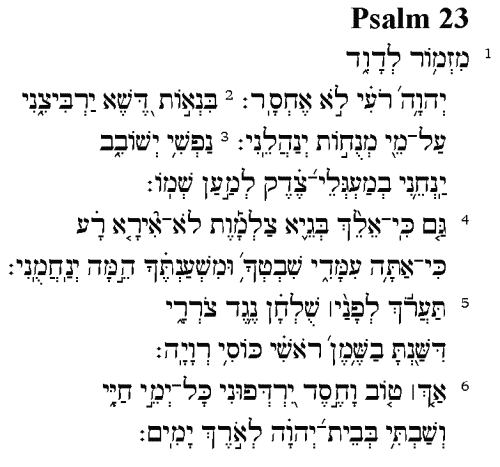
In other words, the 'cup' is an idiomatic way of expressing the dual sanctions (blessing and cursing, Deut. 28) of the covenant -- a sign of fullness/blessing from YHWH for the righteous (Psalm 23:5) and a sign of divine judgment from YHWH against the wicked (Psalm 73:5).

When Jesus asks Peter, "Shall I not drink the cup that the Father has given me?" (John 18:11), it's quite clear what 'cup' Jesus is talking about -- the cup of God's divine wrath. Of particular interest is the way all three Synoptic Gospels record the institution of the Lord's Supper and the passing of the 'cup' (Matt. 26:26-29; Mark 14:22-25; Luke 22:14ff) in juxtaposition with Jesus' agonizing Gethsemane prayer to let the 'cup' pass (Matt. 26:39; Mark 14:36; Luke 22:42). Coincidence??

What emerges from these Gospel accounts of Jesus' final moments prior to his crucifixion
is the way that Jesus brings together these two strands, these two sanctions of the covenant -- blessing and cursing -- in one grand eschatological pronouncement. The cup of wrath is transformed into a cup of grace. Why? Because Christ bears the cup of wrath for his people so that they might experience the cup of grace!

There is an inseparable correlation between the two -- they hang or fall together. If you get rid of or redefine the category of 'covenantal wrath' as viewed from the vantage point of the 'cup' metaphor, then you are inevitably going to misunderstand if not altogether obscure the basis for God's granting 'covenantal grace' to His people.

Here is one key example of why you can't reduce all covenants to pure grace. Certainly the outcome of Jesus' bearing the Father's wrath is one of 'grace' to us (the application of redemption). But in looking at the covenant between Jesus and the Father (the pactum salutis), it's difficult to understand how drinking the cup of divine wrath can be interpreted as being 'graced' by the Father. That certainly would be a rather strange definition of grace!

This also helps illumine the context of Paul's lengthy treatment on the Lord's Supper in I Corinthians 10-11, particularly as it relates to the dual covenantal sanctions. Paul describes the Supper as a 'cup of blessing' for the Church (I Cor. 10:16). Further, he equates the cup with the New Covenant (I Cor 11:25). So far so good...but it's not the end of the story. So much of the 'discussion' in Chapter 11 has centered on what Paul means by 'examine himself' (11:28) and 'discern the body' (11:29). However we take Paul's language in vs. 27-29, it's clear that whoever this person is that drinks in an unworthy manner, that person drinks judgment on himself. How can something be a 'cup of blessing' and a 'cup of judgment'? Could it be that Paul is using 'dual sanctions' of the 'cup' in I Cor. 10-11 as a way to explain the antithesis he previously articulates between 'the cup of the Lord' and 'the cup of demons' (I Cor. 10:22)?

Whatever be the precise nuance in I Corinthians, the 'cup' image returns in full force when we come to John's Apocalypse. This is not surprising, given the way in which Revelation builds upon, interprets, and Christologizes the prophetic works of the OT. Chapters 13-19 make particularly good use of the 'cup of wrath' image, as the cycles of judgment escalate towards the final judgment! What Obadiah sees from far off, John sees from a closer vantage point...but they both have the 'end' in view.

To conclude on a practical note, some one approached me after this particularly Sunday School class and made the comment, "Now that's a subject that I would have never heard at ________ Church. The word they always liked to use was 'brokenness'! You might have heard a sermon about drinking wine at ________ Church, but you would have never heard a sermon about drinking wrath. "

As I thought about this further, particularly as it relates to a certain mindset in some Reformed circles, it occurred to me that this so-called 'recovery of the arts' among Reformed Christians is actually muted by (post)modern, theological reductionism. That is, they like the Old Testament's artistic images that describe 'brokenness' and God's delivering us out of such 'brokenness'. But they don't particularly like the Old Testament's artistic images that describe the cup of wrath as a drunk woman who gnaws on shards and tears out her whoring breasts (Ezekiel 23:32-34).

Part of the brilliance in the OT prophetic literature is its ability to use idiomatic metaphors to enlighten the *fullness* of God's covenantal dealings with the world! This is particularly true when you look at the 'cup of wrath' -- the idiom helps to put human flesh on the notion of 'divine wrath' (which easily becomes theologically abstract without it).

It's not that the imagery/metaphor of 'brokennes' is a bad one or an unimportant one (cf. Psalm 109:16, Isa. 30:26, and more). The problem is that it's not a branch strong enough to carry the theological weight placed upon it by those that seem to refer to it all the time.

Friday, April 20, 2007

Meredith Kline (1922-2007)

And beginning with Moses and all the Prophets, he interpreted to them in all the Scriptures the things concerning himself…Then he said to them, “These are my words that I spoke to you while I was still with you, that everything written about me in the Law of Moses and the Prophets and the Psalms must be fulfilled.” Then he opened their minds to understand the Scriptures. (Luke 24:27, 44-45, ESV).

I have often wondered what the men on the road to Emmaus (not to mention Jesus own disciples!) must have been thinking to themselves when Jesus explained the vast contours of the Old Testament as speaking about himself.

I also wonder if it might have been faintly analogous to the new seminary student who feels like he has a decent grasp of the whole Bible…only to discover that was not the case after the first class of Meredith Kline’s Pentateuch course.

Wonder? Confusion? Excitement? Anger? Amazement?

If there was an ‘Emmaus Road’ event in the Westminster curriculum, it would have to be Dr. Kline’s Pentateuch class that all new students took in the Spring semester of their first year. I suspect many a student of Dr. Kline’s over the years can trace their own understanding of the Law, the Prophets, and the Writings as beginning (in some sense) here. Many (including myself) have not been able to read the Bible the same ever since. Our minds were opened to understand the Scriptures!

When I started in the Fall of 1997, the build up was already beginning for Dr. Kline’s ‘decent’ upon Westminster California in the Spring. Upper classmen started telling us ‘newbies’ things like, “Prepare for the ‘Eschatological Submarine’!” or “Don’t sit on the front row in class, or the Glory Cloud might consume you!” I remember asking an upper classman where Dr. Kline spent the rest of the year, and the student responded: “Supposedly he has a house back East; but we think he’s actually recharging in the Upper Register.” [What is a new student suppose to make out of that?] I distinctively remember a number of first-year students saying they were going to try to get a jump start on the Spring semester by reading Professor Kline’s massvie Kingdom Prologue, the main textbook for the course. Note especially that word, try!

On the first day of class in the Spring, Dr. Kline proceeded into one of his ‘majestic’ prayers that would characterize the beginning of each one of his classes; and this surely gave credence to the rumor that Dr. Kline spent the rest of the year in the Upper Register! He soon announced that this was his 50th year of teaching, which only added to his aura. I recall looking around the room and saying to myself, “This guy has been teaching longer than any of us has been alive!”

Much has been made about the ‘wordy-hyphenated’(!) writing style we encountered in accessing Dr. Kline for the first time. For sake of brevity here, none such examples will be cited! However, for all the difficulties one encountered in reading Kline for the first time, I found his lectures extremely helpful at clarifying what we were trying to comprehend in Kingdom Prologue. I, along with a number of other students who had Dr. Kline as a professor, have commented on the difference in level of comprehension among those who only read Kline and those who were actually taught by him in the classroom. His ability to explain things via his near-frantic use of the chalkboard is something that only his students were able to encounter; however, in the midst of the chalk dust clarity came. I privately wonder if many who still have such a disparaging view of Dr. Kline would have that spirit of criticism if they had sat under his teaching for a semester or two.

In 1997, one of the big issues circling the campus (and our Reformed denominations at large) was the Framework interpretation of Genesis 1 and 2. For many, this issue was (and still unfortunately is) the sin qua non of Dr. Kline’s theology. I have often thought it unfortunate that those who found themselves at odds at this point with Dr. Kline have often failed to consider whatever else Dr. Kline might have to say about the Bible. Such neglect is really to their own detriment, for it really fails to see the importance that Covenant Theology played in the overall thrust of Dr. Kline’s theological endeavors.

Never one to run from controversy, Dr. Kline always displayed cordiality towards those in the classroom who would openly challenge (and sometimes with a certain amount of hostility!) the views presented in the lectures. Kline never responded with vitriol or sarcasm but calmly attempted to answer the objections raised. There was one particularly memorable outburst in which a student rather rudely declared, “Dr. Kline, thank you for correcting God!” I fully expected that this student might have finally pushed Dr. Kline over the edge. And if there was ever a case for a professor to put his student in his place, this was it. But Dr. Kline politely said he was sorry that the student felt that way, and that he would be happy to take up some of those objections after class. If patience towards difficult and ignorant students had any meritorious value in final justification, then Dr. Kline might very well have set the bar so high that few others could achieve it. (Thankfully, his covenant theology new better than to trust in such Spirit-wrought patience!)

Conversations with Dr. Kline after class were always a strange combination of brilliance and humor. I recall telling him one day after class that I found out about a PCA church that was using his By Oath Consigned in their membership introduction class. He immediately shook his head, and in smiling disbelief retorted, “Oh, those poor people!” He also had a large number of quotable zingers, my favorite of which was: “Theonomists don’t want to evangelize the world; they want to destroy it.”

Now nearly a decade removed from Dr. Kline’s teaching, I’d like (in good Klinean fashion) to highlight ‘seven’ ways in which Dr. Kline’s teaching has been instrumental in my own life. [Note, they do not follow a triadic (3+3+1) pattern!]

First, I arrived at Westminster as something of a ‘recovering dispensationalist’! I had read and studied enough from within dispensationalism to realize that it was wrong, but I wasn’t really sure what should be put in its place. Dr. Kline provided the structure I needed to realize the errors of dispensational bifurcation without throwing away legitimate covenantal discontinuities in the process. Few (if any) understood the basic errors of Pre and Post-millennialism as well as Dr. Kline. Reflecting over the past 8 or so years on all of the covenantal confusion that persists under the broad umbrella of so-called Reformed theology, I realize now how insightful (and helpful) he was in helping me understand Covenant Theology was not an imposition of the Reformers but rather was the result of careful reflection of the Scriptures. And when detractors accuse Dr. Kline of being a ‘leaky-dispensationalist’, it makes me seriously doubt that they are reading him (or the Scriptures) carefully.

Second, Dr. Kline was always rigorously exegetical in his approach. Never one to simply rest on the laurels of century old Confessional documents, Dr. Kline was resolutely interested in explaining theology from the text within the larger redemptive-historical panorama of Scripture. His classes reinforced this method from start to finish. Dr. Kline’s insistence on being first and foremost Biblical has been an extremely valuable lesson, particular as I interact with Christian laymen, as well as Christian academics, who know very little about the Reformed Faith.

In many respects, Dr. Kline’s exegetical rigor came at precisely the time when my ‘historical traditionalism’ needed a good slap in the face. At a time that I was very much looking for theological stability in the glories of past church history (ancient, medieval, Reformation, post-Reformation, Modern, Postmodern, etc.), Dr. Kline stood as a stark reminder that all traditions must always subject themselves to exegetical scrutiny…even his own teaching. If anything this has given me a greater appreciation for our Reformation forefathers and their attention given over to expound the Scriptures.

Whether exploring of the oft-mysterious work of the Holy Spirit in his Images of the Spirit, the role that covenant plays in establishing the canon in The Structure of Biblical Authority, or the eschatology of Zechariah's night visions in Glory in our Midst, at every point Kline never failed to argue his point from the text of Scripture.

Third, Dr. Kline was passionate in defending the Protestant doctrine of Justification by Grace alone, through faith alone, in Christ alone. These were doctrines that I would have heartily affirmed when I first set foot on the Westminster campus, but Dr. Kline explained these in all of their Biblical-Theological fullness. I’ve encountered a number of people since seminary that were convinced that Dr. Kline’s criticism of Norman Shepherd’s views of justification was personal, when in fact it was nothing of the sort. Dr. Kline had one unified interest: to speak clearly on the question of the grounds of the believer’s justification before God; and, conversely, to speak out against any theologies that might detract from clarity on justification.

In recounting the details of the Shepherd Controversy, Dr. Kline understood from the very beginning precisely what was at stake – the Gospel of Jesus Christ. But it was his covenantal understanding of the issues that made his contribution to the discussion so vital. I distinctively remember him explaining the importance of the ‘Covenant of Works’ insofar as it provides the covenantal backdrop for the active obedience of Christ imputed to the believer, and how Mr. Shepherd’s system of theology completely obliterates this. Interestingly, Dr. Kline first pointed out this error in Shepherd’s theology a quarter-century before Mr. Shepherd finally came around to explicitly denying Christ’s active obedience as part of the righteousness imputed to the believer. Dr. Kline’s understanding of the Scriptures within their Covenantal framework enabled him to see the logical end of errant theologies of justification, sometimes long before they realized it for themselves.

Fourth, Dr. Kline was the final lynch pin in convincing me of the paedobaptist position. I read John Murray’s Christian Baptism, as well as a few other standard books on the subject, prior to my coming to seminary. But none of those were successful in convincing me of the issue. Once Dr. Kline explained baptism within the dual sanctions of God’s covenantal dealings with man (e.g. By Oath Consigned), the ducks finally started to line up and make sense. Connecting baptism to the story of redemption made for a tour de force argument for paedobaptism. Few (if any) other works on the subject of baptism take notice of this, and his unique contribution on this very point makes so much sense out of NT passages that are difficult for many to understand.

Fifth, Dr. Kline modeled Reformed Old Testament scholarship in a way that was (and still is) so uncommon when you compare it to the hodge-podge of evangelical Old Testament scholarship done today. As one who continued on after my time at Westminster in the field of OT studies, it is virtually the universal norm that you have on one side the Semitic scholars who have precious little interest in theology, and on the other side you have the so-called ‘OT theologians’ who abstract interesting propositions without any careful examination of the text. Thankfully, Dr. Kline knew better than to divorce theology from Semitics. He was rigorous in his demands of students to know the Hebrew from the passages we were covering in class. I remember talking to him about doing graduate work in OT, and his advice to me was to devote my time to studying Semitics….and to use that as the basis for later theological reflection in writing. That nicely summarizes the basic approach that Dr. Kline modeled again and again – the best Biblical theology is one that is rooted in the text, informed by the various covenants in Scripture, and unveiled as part of the unfolding story of redemption from Genesis to Revelation!

It has become one of my 'unofficial' habits to read through Kingdom Prologue once a year. Now going on 8 or so years of doing so, it is remarkable that I continue to find exegetical and theological nuggets of profundity that I somehow ‘missed’ upon previous readings. It makes me wonder how much of KP I truly grasped when I first read it in 1998. 20%? 10%? This highlights how sorely ignorant we (the church) are of genuinely insightful reflections on OT (and NT) theology. The problem that people continually have with Dr. Kline exposes our unfamiliarity with the principal data (the Scriptures) of our theology. Far from ‘fanciful exegesis’, Dr. Kline dared to explain in the text what few others would.

Sixth, Dr. Kline’s insights into the ‘works principle’ in the Mosaic covenant are among the more controversial aspects of his theology, but they have proven beneficial to myself when I began to actually work through various parts of the OT, whether it be the book of Leviticus, the book of Joshua, or the prophesy of Zephaniah. The seminary curriculum did not permit Dr. Kline the occasion to work through each of these books with the students. And yet the way in which he taught the OT enabled me (and surely countless others) to move into these other portions of scripture with understanding of the ‘big picture’ of life under the Mosaic epoch.

Seventh (and lastly, following the esteemed Dr.’s love for the ‘sabbatical rest’ pattern of Scripture!), one could not conclude any reflections of Dr. Kline without mentioning his love for the Book of Revelation. That raises a most conspicuous question – since when does an OT scholar of Dr. Kline’s caliber cite a NT book as his favorite text? But this explained so much about Dr. Kline’s love for Biblical theology and its God-ward, heaven-ward trajectory. When you look at the warp and woof of Dr. Kline’s impressive resume of ground-breaking OT work – the Imago Dei in Genesis 1, the Covenant of Creation under Adam, the common grace covenant with Noah, the ratification-oath-pledge by God to Abraham in Genesis 15, the Suzerain-treaty form of the Works-covenant under Moses, the intrusion of curse-ethics under the Canaanite conquest, the little-apocalypse of Isaiah 24-26, the eved-YHWH of Isaiah, the protological-prosecutorial-eschatological role of all the Prophets, and many, many other themes/texts – it should be clear why Dr. Kline would love any book of the Bible that is capable of bringing all of these organic strands of OT revelation together with vivid apocalyptic brilliance, anti- and arch-typical fulfillment, eschatological resolution, and Christo-centric finality. How could one not love the Book of Revelation as a result?

It is indeed fitting that the final chapter in his final work (unless a posthumous work surfaces!) in God, Heaven, and Har Magedon – one third of the book no less – was devoted to the grand ‘Messianic finale’ as given in Revelation. This is Dr. Kline at his best, still sharp as ever at the end of his earthly pilgrimage, still motivated to expound the glories of the resurrected Christ seated in the heavenly places!

We give thanks for the allotted time given by the Lord for Dr. Kline’s long ministry to so many students over the decades here in the ‘lower register’! Though we grieve the loss of a great servant of the Lord, we rejoice in the hope that so saturated Dr. Kline’s teaching from beginning to end:

“We have a building from God, a house not made with hands, eternal in the heavens.”
(II Cor. 5:1)
“For Christ has entered, not into holy places made with hands, which are copies of the true things, but into heaven itself, now to appear in the presence of God on our behalf.”
(Heb. 9:24)
“Blessed are those who wash their robes, so that they may have the right to the tree of life and that they may enter the city by the gates…The Spirit and the Bride say, ‘Come.’ And let the one who hears say, ‘Come.’ And let the one who is thirsty come; let the one who desires take the water of life without price."
(Rev. 22:14,17)


Dr. Kline’s homecoming has begun, and no doubt he is loving the ‘indoxation’ of Heaven even more than he could ever had done so while speaking about it as a 'pilgrim' on the road to glory.

As he was often heard in class praying, “Even so Lord, come quickly!”

_______________________
Matthew Ashley Morgan
April 19th, 2007
for the Westminster Alumni Reflections of Dr. Kline,
to be given to his wife and family