He who hears the shema drinks the shekar!

Showing posts with label Covenant Theology. Show all posts

Monday, November 12, 2007

Too many books, anyone?

Andrew T. B. McGowan makes an interesting comment about Thomas Boston's federal theology:

The fact that Boston had so few books clearly meant that he devoured whatever came into his hand, and his treatises on the covenant of works and the covenant of grace display a familiarity with Witsius.
(pg. 9)

I must confess that it's easy as a covenant theologian to run like gangbusters to the later half of McGowan's statement. And what's not to like about that! McGowan goes on to argue that the formative influences on Boston's covenant theology stem from those Reformed luminaries known as Ursinus, Beza, and Witsius. Pretty good company!!

However, it's the first part of McGowan's comment that really caught my attention. That is, the fact that Boston had "so few books"! McGowan footnotes this to something found in Boston's
Memoirs (so lets assume for sake of argument that it's true). Without extrapolating into *why* Boston acquired "so few books," this struck an interesting personal chord into my own book-reading and buying habits.

Reformed theology has long been known for its love of reading books. With that often comes a love for collecting books and buttressing one's library. There may not be a blatant attempt to impress others with our vast collection of reading...but we certainly don't seem to mind when people think we are extremely well-read! I remember the vast array of books I started to collect as an undergraduate and then the year I took off before I started at Westminster. I was a book hound! The art of learning how to read through that process was immeasurable, especially going into seminary and then more graduate school, where you are forced to assimilate large amounts of data in a short period of time.

However, what I've learned through it all is simply this: at least 95% of the books being published out there in theology, Biblical studies, and the like are simply not worth much more than a quick glance, only to be filed away to the bin of the 'books that made it to print that probably should have gone into the doc shredder.'

When I moved to Canada in 2004, I sold (or gave away!) probably in the neighborhood of 80% of my library. It wasn't easy to part with a lot of those books that were part of the journey through college and seminary. At the time, my reason was largely pragmatic -- I didn't see the point in spending hundreds in shipping books postal rate, only to have them thrashed in the process!! Plus, I figured that most of these books I could re-purchase at some point in the future, if I decided that I really needed it again. And besides -- I had the Regent Library on hand to look up a reference or quote if really needed.

But the fact of the matter is that haven't missed hardly any of these books I gave away. In fact, I can't really think of one time where I've said to myself, "Why did I get rid of THAT book?" These were books that served their purpose along the way...but they were books that frankly would be filling space on my bookshelves, not to mention making it that much harder to move to and fro.

So my philosophy of book-buying has evolved quite a bit since I started seminary a decade ago. I still try to read as much as I can find the time....but the difference is that I am much more picky in the books that I will actually add to my personal library. Of course, there are other factors involved here, like the fact that I've had reasonably good theological libraries in Vancouver and now Berkeley to consult when needed. Perhaps wisdom taught me that you don't need to buy every book under the sun, when you can simply consult it down the street.

And that brings us back to Boston's "so few books"! Suddenly, the lack of books on the shelf doesn't seem like all that bad of an idea. On that rare occasion that a book is actually worth more than a single read, then perhaps you have a book worth purchasing for your library! Devour the really good books again and again....and skim quickly through the rest!

How many books on your shelf would you be willing to part with? What percentage of your books have not been touched on your bookshelves in the last 3 years? [Moving or re-arranging doesn't count!]

NOTE: I just discovered the top 10 things to say after returning home from a conference book plunder! Hilarious -- it proves my point exactly!

Thursday, August 23, 2007

A Cup of Wrath...Anyone?

While working through Obadiah during our summer Sunday School series, I made the decision a couple of Sundays ago to do an excursus on Obadiah 16; that is, how does the image of 'drinking' tie into the 'cup of wrath' metaphor in the eschatological outlook of the Bible?

It's a massive topic, one that occupies no small place in the Hebrew prophets (e.g. the 'cup of wrath' image -- if not the actual phrasing -- appears in over 30 places). However, it's a helpful example of seeing how such Biblical metaphors (e.g. what Dr. Kline labelled 'prophetic idiom') function within the prosecutorial-lawsuit focus of the prophets.

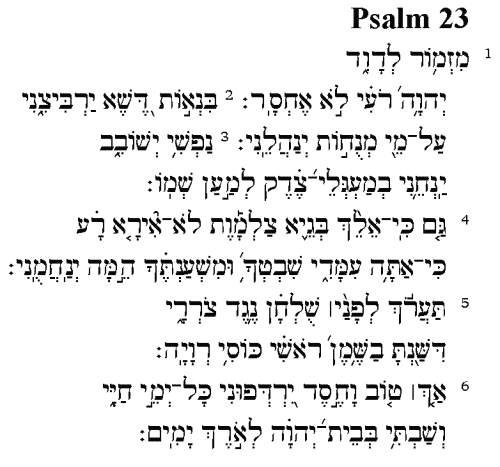
In other words, the 'cup' is an idiomatic way of expressing the dual sanctions (blessing and cursing, Deut. 28) of the covenant -- a sign of fullness/blessing from YHWH for the righteous (Psalm 23:5) and a sign of divine judgment from YHWH against the wicked (Psalm 73:5).

When Jesus asks Peter, "Shall I not drink the cup that the Father has given me?" (John 18:11), it's quite clear what 'cup' Jesus is talking about -- the cup of God's divine wrath. Of particular interest is the way all three Synoptic Gospels record the institution of the Lord's Supper and the passing of the 'cup' (Matt. 26:26-29; Mark 14:22-25; Luke 22:14ff) in juxtaposition with Jesus' agonizing Gethsemane prayer to let the 'cup' pass (Matt. 26:39; Mark 14:36; Luke 22:42). Coincidence??

What emerges from these Gospel accounts of Jesus' final moments prior to his crucifixion
is the way that Jesus brings together these two strands, these two sanctions of the covenant -- blessing and cursing -- in one grand eschatological pronouncement. The cup of wrath is transformed into a cup of grace. Why? Because Christ bears the cup of wrath for his people so that they might experience the cup of grace!

There is an inseparable correlation between the two -- they hang or fall together. If you get rid of or redefine the category of 'covenantal wrath' as viewed from the vantage point of the 'cup' metaphor, then you are inevitably going to misunderstand if not altogether obscure the basis for God's granting 'covenantal grace' to His people.

Here is one key example of why you can't reduce all covenants to pure grace. Certainly the outcome of Jesus' bearing the Father's wrath is one of 'grace' to us (the application of redemption). But in looking at the covenant between Jesus and the Father (the pactum salutis), it's difficult to understand how drinking the cup of divine wrath can be interpreted as being 'graced' by the Father. That certainly would be a rather strange definition of grace!

This also helps illumine the context of Paul's lengthy treatment on the Lord's Supper in I Corinthians 10-11, particularly as it relates to the dual covenantal sanctions. Paul describes the Supper as a 'cup of blessing' for the Church (I Cor. 10:16). Further, he equates the cup with the New Covenant (I Cor 11:25). So far so good...but it's not the end of the story. So much of the 'discussion' in Chapter 11 has centered on what Paul means by 'examine himself' (11:28) and 'discern the body' (11:29). However we take Paul's language in vs. 27-29, it's clear that whoever this person is that drinks in an unworthy manner, that person drinks judgment on himself. How can something be a 'cup of blessing' and a 'cup of judgment'? Could it be that Paul is using 'dual sanctions' of the 'cup' in I Cor. 10-11 as a way to explain the antithesis he previously articulates between 'the cup of the Lord' and 'the cup of demons' (I Cor. 10:22)?

Whatever be the precise nuance in I Corinthians, the 'cup' image returns in full force when we come to John's Apocalypse. This is not surprising, given the way in which Revelation builds upon, interprets, and Christologizes the prophetic works of the OT. Chapters 13-19 make particularly good use of the 'cup of wrath' image, as the cycles of judgment escalate towards the final judgment! What Obadiah sees from far off, John sees from a closer vantage point...but they both have the 'end' in view.

To conclude on a practical note, some one approached me after this particularly Sunday School class and made the comment, "Now that's a subject that I would have never heard at ________ Church. The word they always liked to use was 'brokenness'! You might have heard a sermon about drinking wine at ________ Church, but you would have never heard a sermon about drinking wrath. "

As I thought about this further, particularly as it relates to a certain mindset in some Reformed circles, it occurred to me that this so-called 'recovery of the arts' among Reformed Christians is actually muted by (post)modern, theological reductionism. That is, they like the Old Testament's artistic images that describe 'brokenness' and God's delivering us out of such 'brokenness'. But they don't particularly like the Old Testament's artistic images that describe the cup of wrath as a drunk woman who gnaws on shards and tears out her whoring breasts (Ezekiel 23:32-34).

Part of the brilliance in the OT prophetic literature is its ability to use idiomatic metaphors to enlighten the *fullness* of God's covenantal dealings with the world! This is particularly true when you look at the 'cup of wrath' -- the idiom helps to put human flesh on the notion of 'divine wrath' (which easily becomes theologically abstract without it).

It's not that the imagery/metaphor of 'brokennes' is a bad one or an unimportant one (cf. Psalm 109:16, Isa. 30:26, and more). The problem is that it's not a branch strong enough to carry the theological weight placed upon it by those that seem to refer to it all the time.

Monday, February 19, 2007

My own impish way...

T. David Gordon quote of the day:

"My own impish way of discerning whether a person really has an understanding of covenant theology is to see whether he can describe it without reference to dispensationalism."


So very true!